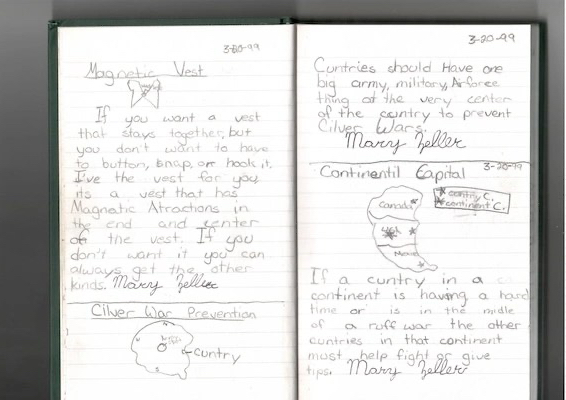
I’m a little hesitant to share this (brilliant!) idea, because I’m pretty sure I’m channeling the same aspects of my personality that convinced my 10-year-old self that these country organization inventions (see photo) were going to save the world… I’m now 35 (I think. I had a kid recently and the past 3 years are a blur), and I’m also aware that I’ve never bothered to study political science and that I’m not (very) well read.
But, I have been thinking a lot about character arcs, and I believe there’s something to be gained from thinking of Countries in this context. (I know this is quite simplistic… Bear with me :))
First, we should think about what a story is and why we need them. (I haven’t come up with this by myself, I’m ladling from the soup in my scull that is mostly influenced by Lisa Cron’s Story Genius (http://wiredforstory.com) and Diana Wynne Jones’ Reflections on the Magic of Writing)
Stories (most of them, I haven’t read widely enough to say all) are generally about an external construct (plot) which perfectly forces a main character to struggle internally in order to learn (or refuse to learn) a specific difficult lesson and then be changed (or not changed). We need stories to go through the process of change virtually, so that we don’t have to go through all of the very painful parts of the raising action in reality (we can create an identity for ourselves separate from what our parents say we are before we run away from home, we can fix our marriage before it breaks, we can go on an adventure before we’re old and our back pain is unbearable, etc…)
So in short, a story is about a character arc, and is told to a reader (by a writer) so that the reader (and writer) can be better equipped to have a rewarding life. Pretty awesome, huh?
But what about beyond the individual character arc? What about societies, countries, residents of earth? Is there no virtual reality for us to learn from without having to go through all the pain for reals, in conflicts that a larger than any one individual?
Of course I’ve been thinking of this because of current events. I’m following the Israeli-Hamas war from my home in Germany, and I’ve been thinking that, if this were fiction, this war could bring about the perfect crisis in a Germany character arc (I am definitely not trying to imply that the German perspective is the most important here… far from it (very far from it). I’m just using it as an example because I live here, I love living here, and my observations of the internal struggle were the inspiration for the post).
Let me explain. In order to process the responsibility for the Nazi era, to reject Nazism, and especially in order to feel like a country of humans rather than a country of monsters following multiple genocides (the largest being the Holocaust), Germany recreated itself after WWII with some very foundational beliefs about what Germany meant moving forward. I definitely don’t know all of the developmental links in these beliefs between then and now, as Germany is a country of 84 million and at least three generations have passed (and I’m only a new immigrant after all, and I feel like I’m saying all of this like a backseat driver, or a mostly deaf great-aunt… which is to say, this is not actually my area of expertise. I just feel compelled to share my thoughts, and I have just enough presence of mind to suspect that they might not always be helpful).
But, I know that Germany very firmly believes that the security of Israel is its reason of state, and that Germany has given itself a universal jurisdiction to prosecute war crimes and crimes against humanity, for anyone (including perpetrators with no connection to Germany when the crime was committed with no connection to Germany), and that these beliefs have developed as a necessary part of how Germany copes with its past. So Germany sees itself as a protector of Israel, and a protector of human rights and dignity the world over. These two very firmly held beliefs are not always at odds.
But (I apologize in advance for being very callous here) the dramatic question, if this were a fiction or dramatized non-fiction, would be “If Israel commits war crimes in Gaza, what will Germany do?”. This might be easy to answer from the outside, but to Germany this poses a question of crisis proportions (and is likely one Germany wants to avoid answering at all costs). This is not just a random curiosity on my part. This matters to me, because without the virtual world of fiction as a model (with the arc in this hypothetical story focusing on a country or a society) there aren’t easy ways for us to play this out except for in reality. Where real people suffer for real.
There are many questions that could bring crises in various countries (What is freedom without reparations? Are monarchies humanist (and are they entitled to all that land)?, Where do we place pedestrians in a society built around cars?). And there are many global pressures which bring questions on an even larger scale (post-colonialism, climate change, to name a few). These are pressures and questions that probably can’t be addressed by any one individual. And probably (despite Hollywood stories saying otherwise) not even one well-positioned individual. And also probably not a larger group of like-minded individuals.
Individuals might know what they would want to have happen, in terms of their country (or humankind globally) sticking with the (mis)-Belief or accepting the Lesson (the Character arc terms I use were taught to me by Ellen Brock). But, they still have to watch it unfold and feel mostly powerless. Without stories, I think these societal divisions just lead to culture wars, real war, or avoiding conflict by maintaining a status quo that only works well for a few. We can always poke holes in someone else’s arguments and facts (even when these have been painstakingly put together and lovingly arranged), but stories force us to be more empathetic, and allow us to agree to concessions and changes without being forced to first.
I know for myself that I want the outcome of the process. I want less wealth inequality, and less racism, and a circular economy where more people can have a better quality of life without burning fossil fuels, and for there to be way way way fewer parking lots, and for people to be able to live honestly in their own skin. That sounds amazing, and once we’re a few generations into it (like living in western Europe 75 years post WWII) almost anything might seem worth it to get there.
But… I honestly get nauseous thinking about my daughter (or myself, or anyone really) experiencing WWIII, which after the pandemic and multiple wars, does not sound unlikely. So I have to ask, is there any way to get from A to B virtually? Would having a new type of story (and who knows what that would look like) with a character arc following countries or societies help us, as a we, imagine our collective selves better, and help us learn a lesson virtually to make everything better in reality? (without quite so much despair and destruction along the way)
Ok… that was better thought out than when I was 10. But really it still has a lot in common with what I could come up with then… and I still feel a disconcertingly familiar combination of satisfaction and silliness.
Cheers 🙂
p.s. Writing this has prompted all sorts of mental side trips (like… what do we have now that maybe does something similar? What would these stories look like? Would they be fundamentally different than propaganda, or meme? What is the role of history, or news, and how it written/shared?). If I write any future blog posts on a semi-connected theme, I’ll link it below.
 Take a walk with me
Leave a comment